Tuesday, April 7, 2015

Irish/English aka Gaelscoilis (#7)

I love Ted talks. This is a Tedx talk done in Dublin on schoolkids who go through language immersion in Irish and apply certain linguistic properties of English to it. The speaker is a language teacher who is noticing the difference in these school children speaking and true native speakers of Irish. Now the goal in this context is not to create a new creole but to have bilingual speakers. He has a solution that will allow this to occur. At the end he expresses the issue as being an inability to express oneself emotionally in Irish causing a reliance on the English-isms to complete that part of speech. His solution is to integrate the everyday words in Irish into the classroom rather than the specialized scholarly communication which is currently in use.
Honestly, I don't know what to think about this. I can see when trying to reintroduce a language how this might be an issue but at the same time there is a blockage of creativity. These kids are using a slang which occurs in every single culture in the world. The youth inventing new words and new patterns is what keeps a language alive. I realize that Irish as a language was beaten out of their great grandparents and grandparents so a reintroduction must occur and at the same time care must be taken not to stunt the growth of a language.
Very informed, informative and interesting it is nice to know what is going on with the language reintroduction in Ireland. I really hope it is successful, it is such a beautiful language. It might be nice to discover an additional Creole in a hundred years time. Who knows what will come of this Gaelscoilis.

Tuesday, March 24, 2015

Pronunciation and Polyglots (#6)

The following video is a mixture of very encouraging and incredibly humbling. A few years ago when attempting to understand my Swiss friend who grew up speaking two languages in her home, learned two more in school and was becoming fluent in two more during her gap year, I came across a video on polyglots.  One of the people in this video was a young kid who was in New York and becoming very good at learning new languages. His name is Tim Doner and he is a polyglot. He has a debatable number of languages but more than 10 under his belt.


He touched on a couple of things which I know I wouldn't be able to do. The first of these is accents. He got to brag about all those accents he could do as a kid, I on the other hand have been told I speak Turkish with a Spanish accent and Spanish with an American accent. I just can't win with the accent game. Being able to place the pronunciation of words correctly in my mouth in relationship to how I hear them is just not in my skill set.  Practice has helped in hearing differences, for example in how Brits pronounce Carrie and Kerry but not in actually verbalizing.
The second thing Tim mentioned regarding sound was the fact that he played with word association as a memory cue. He did it by memorizing words according to the sounds of the words. If words sound alike then in my brain they must be related. That isn't necessarily true, for tenses it may be but when it comes to nouns this is frequently false. For cognates this has been advantageous but their are some words this is not helpful. In Spanish there is 'el Papa', 'la papa', and 'el papá'. For a non native speaker of Spanish it is notoriously difficult to figure out the difference in pronouncing for 'the Pope', 'the potato' and 'the father'. Similarities can be distracting rather than helpful for me. Amusing sure but not helpful in learning a language.  
That's not going to stop me from trying!

Tuesday, March 10, 2015

Big Bang's Maxims

Who doesn’t like a fun video to illustrate a concept? The video below illustrates Grice’s four maxims.

1. The principle of Truth
2. The principle of Information
3. The principle of Relevance
4. The principle of Clarity


As a character Sheldon seems to be completely unable to respond to these four conversational maxims derived from the concept of implicature. In three scenarios the explicitly stated text is not the intended meaning when someone else is saying it. In one scenario, when he is speaking, the other characters in the scene decide to give another meaning to his words in order to amuse themselves. 

This not only is a perfect illustration of how important understanding the implications of our speech truly is but it is also really amusing. It is fascinating that since the origination of the pun the implications of statements have become an intrinsic part of comedy. Now that we have moved into the internet age we are able to give further rein to implied versus literal meaning in everything from short scripted videos like the above to memes and blogs.


Enjoy the rabbit hole!

~ Sarah

Thursday, February 26, 2015

Pronunciation in English: Learn it or Teach it? (#4)

Difficult Pronunciation Poem

The most difficult poem in the English language. Of course that is my opinion but this poem is Dr. Seuss on steroids. I saw this poem a few years back and I couldn’t believe it. Though there are several sites which have this poem this one had the pronunciation of it, which is immensely helpful. Below is a brief sample.
  
    Just compare heart, beard, and heard,
    Dies and diet, lord and word,
    Sword and sward, retain and Britain.
     (Mind the latter, how it's written.)
     Now I surely will not plague you
    With such words as plaque and ague.
    But be careful how you speak:
    Say break and steak, but bleak and streak;
     Cloven, oven, how and low,
     Script, receipt, show, poem, and toe.

When I taught English it was to young children who would be able to pick up the differences in much the way a native speaker would. In this poem by Gerard Noist Trenité, a Belgian, I have found the worst of the English language and really not how difficult it is to learn but how difficult it is to teach. I will never know how difficult it is to learn English as an adult but this poem’s last line states “My advice is give it up!” Which would be very, very tempting.


Pronunciation even varies dialectically making the proposition of pronouncing these "correctly" even more difficult. There is a broadly correct pronunciation but some of the words as pronounced by someone in Darwin, Australia would differ greatly from Aberdeenshire, Scotland. We do know how to read it but I'm not sure there is always a correct way of pronouncing things. As a living language that is something that continually changes.


~ Sarah


Thursday, February 19, 2015

English as a Documentary (#3)

The English Language. Have you ever really looked into its origins, its evolution, its diversity?

One day when I was missing my heart language, my flatmate was out of town, I wasn’t working and the snow was falling fast and furious, I watched a documentary. This documentary was in English about English. Starting with the origins, it went through the great vowel shift that led from Middle to Modern English. Leading all the way up to Creoles, Patois, Accents and Dialects in the modern age; this is one of the most complete overviews of the English language I have ever encountered.

I must say that day I watched this I was enthralled. Not only did this give me a bit of spoken English when I was thirsting for it but I was able to learn a vast deal about my history. In a way our language defines us and for better or worse English defines you. The way in which we perceive and navigate the world is in this medium.

It is long. Really, very, long. And so worth it. If you have a spare hour, or seven, and enjoy a British narrator, take a look and enjoy. Here is a snapshot of the first few minutes so I hope this will get you to watch a bit more on your own. If you don’t have the time or energy for that I would also recommend reading King Alfred’s English by Laurie J. White, it is a book much in the same vein. It follows the course of the English language, which I must admit seems rather fantastical.


Thursday, February 12, 2015

Tongues and Times in Turkey (#2)

The Heart's Language    I lived in Turkey. Did I mention that yet? Well, I did. And Turkey is a beautiful country with a wonderful language. Having lived in Istanbul I was in a much more Western influenced part of the country. I had many opportunities to cross from Asia to Europe each week and see what was the capitol of the Byzntine and Ottoman empires. I never did become fluent after my three years there. I did meet many people and one of them was Charlotte McPherson. Besides owning one of the few bookstores in Turkey which has English language books she writes a column for the English language version of a Turkish newspaper.


     In her article ‘Speaking the heart’s language’ she is able to draw the parallels between Hungarian and Turkish particularly well illustrated in the extract below:


      “Turkish: “Cebimde çok küçük elma var.” Hungarian: “Zsebemben sok kicsi alma van."             
        (Translation: I have a lot of small apples in my pocket.)”


     She is addressing some obvious similarities between not only the words but also structurally in the language. Though she translated it in the traditional American way of saying, which is the best way of conducting translation, a literal translation would follow “Pocket mine in many small apples exist/are/true". Yes, we may be acquainted but I find Charlotte's observations quite astute.
     Not only does she touch on structural values in languages but she goes on to speak on how nice it is to meet people who speak one's mother tongue. One's mother tongue has also come to be known in some circles a your heart language. No matter how many languages you learn the language in which you will best be able to express your emotions will always be your heart language. For most that is the first language you learn.
     I found this very evident when even after living in Turkey, each time I overheard a bit of English conversation it was like a safe have. I recall several times being on public transport, bus, train, ferry, funicular and finding in that mix of languages my mother tongue and relishing in those brief moments when I understood everything that was being communicated. I continue to wonder at people's reactions to their heart language and I'm sure my experiences will continue to inform my life. Taking a moment to address someone in their mother tongue is a treasure, no matter the language they speak.

Monday, January 26, 2015

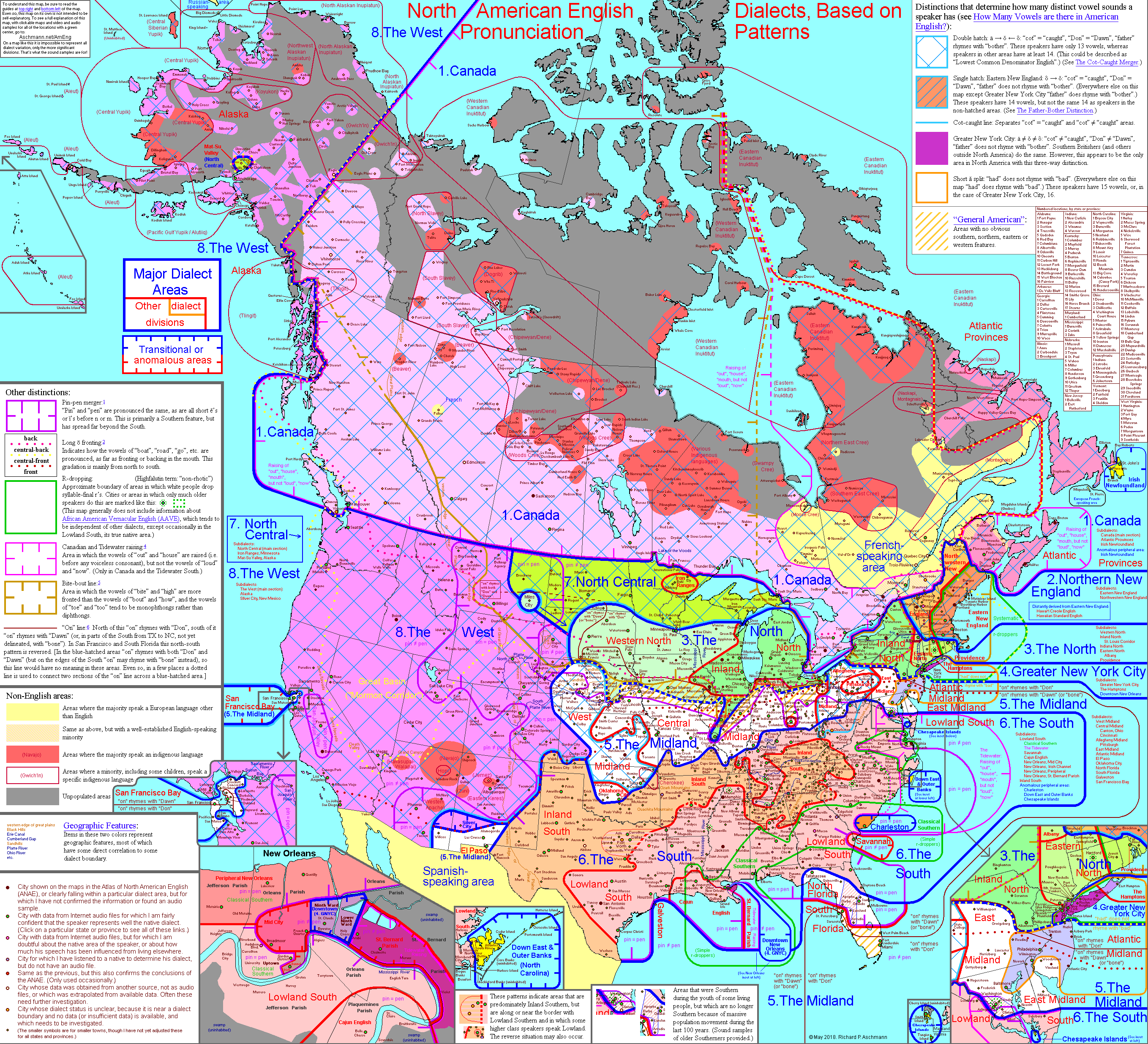
North American Dialects: Where do they stop and start? (#1)

     A couple of years ago I saw an article making the rounds on some of my Facebook friends walls. It was all about the different dialects to be found in the US and Canada and their delineations. I couldn't believe it. Someone had actually answered my question. Where are the regional dialects in the US and what is it that differentiates it from other regions?
     Rick Aschman composed a map from the data provided in the Atlas of North American English (ANEA), which most if not all of the English dialects as well as some commonly spoken native languages North of Mexico. In this map there are 8 broader dialectical families with some variation withing most of them. His map appears below. The link to his main page is here, if you want to take a closer look. I highly recommend that you do.


     I have absolutely no ability to say how accurate this is but if you followed the link you may be able to hear some of the audio files they have in support of this mapping. This is the work of many people over years, maybe decades and I would have to study it for longer than I have been alive to feel comfortable in opining on its validity. It does make me want to look into it further but it does overwhelm a bit. 
     From the time I moved to the US as a child and realized even the people in my extended families did not speak in the same fashion I was curious as could be. My family in Vermont sounded different from that which lived in Chicago and those from Texas did not sound the same as the ones living in North Carolina. Though we all spoke the same language, there were so many shifts in common speaking patterns I would catch myself imitating them after a little time spent listening to them. Each summer after visiting with my Texan cousins I would continue using Ya'll for about a month. 
     I wasn't the only one curious about this. When I lived in Turkey I was asked by several people what my American accent was. The most commonly recognized and imitated the world over is the Southern Accent. I was never able to share what my accent was knowing only that it was American. Now, barring accent shifting from imitating my surroundings, I can say that I have a Western American Accent. Fancy that! 
~Sarah